
Introduction
The Plague epidemic that struck Madras State between 1951 and 1965 marked a critical period in the region’s public health history. This study examines the origins, spread, and eventual containment of the plague during these years. The research is based on an extensive review of historical records, epidemiological data, and government reports, supplemented by press coverage and other contemporary documentary sources to assess the validity of claims.
This study is guided by key research questions: What were the primary factors contributing to the outbreak and persistence of the plague in Madras state? How effective were the control measures implemented by health authorities? What challenges did public health officials face in eradicating the disease? To address these questions, the research employs a historical and analytical approach, utilizing quantitative methods. The hypotheses tested include the significance of coordinated government intervention in disease eradication and the role of socio-economic conditions in epidemic persistence.
The findings of this study highlight the various control measures implemented by health authorities, including quarantine protocols, mass vaccination campaigns, rodent control efforts, and public awareness initiatives. By analyzing the effectiveness of these strategies, the research underscores the importance of a coordinated and multifaceted approach in managing public health crises. Through sustained efforts, Madras State ultimately succeeded in eradicating the plague, offering valuable lessons for contemporary public health challenges.
Historical Overview of Plague
Plague is one of the oldest diseases known to man. It is primarily a zoonotic disease that exists in nature between small mammals, usually wild rodents, and the fleas that they harbour. Plague is endemic in many parts of the World and exists in many small natural foci. It is widely distributed in the tropics and warmer areas of temperate countries. The causative bacteria, Yersinia pestis, can also infect humans. It is transmitted between animals and humans by the bite of infected fleas, direct contact, inhalation, and, rarely, ingestion of infective materials. Untreated plague can be a life-threatening disease with case fatality rates between 30% and 60%. Recent outbreaks have shown that plague may recur in areas that have long remained silent (Bhalwar, 2009, p. 1071).
A significant health issue in many countries worldwide is plague, one of the oldest, most severe, and most potent rodent-borne zoonotic diseases. Plague was identified as a disease by the Bhagavata Purana (155–600 BCE). Throughout India, plague posed a serious threat to public health until the mid-20th century. According to the International Health Regulations, one of the three epidemic-prone diseases that the World Health Organization (WHO) requires notification about was the plague. The main states in India affected by the disease starting in 1939 included Bihar, Maharashtra, Andhra Pradesh, Madhya Pradesh, Karnataka, Tamil Nadu, Uttar Pradesh, and Punjab.
Epidemiology
The disease persists in the districts of the Madras State bordering Mysore and Hyderabad states in a comparatively mild form, and the areas which have reported repeated infection in this state are Harpanahalli, Hagagalli, and Kudligi taluk of Bellary districts, Hindupur taluk of Anantapur district, Madanapalle, Punganur, and Juppam taluks of Chittoor district, Hosur taluk of Salem district, Kollegal, and Satyamanaglam taluks of Coimbatore district, and the Nilgiris district. Epidemics generally spread from these foci to other areas (Report on the Health Conditions in Madras State, 1951, p. 15). Stray cases were reported from the districts of Salem, Chittoor, South Arcot, and Tiruchirappalli, but the majority of cases occurred in Bellary Municipality and Bellary district. The districts of Nilgiris, Coimbatore, Anatapur, and the rest of the State were entirely free from Plague (Madras State Administration Report, 1951-52, p. 99).
1. Outbreak of Plague in Tiruchirappalli District
During the first quarter of 1951, plague occurred suddenly (7 attacks and 6 deaths) in Pasumbalur village of Perambalur taluk of Tiruchirappalli district. Being a “non-endemic” area, the occurrence of the first six cases was missed, and it took some time before the actual situation was realized. The source of infection could not be traced, there being no infection in any of the neighboring endemic areas at that time. The infection was brought quickly under control by the use of Dichloro-Diphenyl-Trichloroethane (D.D.T.), and further cases did not occur (Report on the Health Conditions in Madras State, 1951, p. 16).
2. Plague in Salem District
Plague occurred off and on during the year in some village or other in the Hosur taluk of Salem district. In seven village units which had not been previously treated with DDT, eight attacks and 10 deaths occurred during the period. However, in one of the villages that received DDT treatment 6 months before, only one attack occurred. During the inspection of anti-plague work in Hosur taluk, it was found that an inadequate quantity of 10 percent DDT dust was being used for the rat harbourage insufflation. The occurrence of plague in the DDT-treated village above may likely be due to the inadequate dosage of DDT used. The work has improved in quality since then, and plague has not occurred in any of the other DDT-treated villages in the districts (Report on the Health Conditions in Madras State, 1952, p. 17).
3. Plague in the Nilgiri District
As part of the plague eradication program, DDT treatment had been conducted annually for the previous two years in all plague-endemic villages of the district. As a result, the district remained plague-free from October 1950 to January 1952. However, towards the end of January 1952, an outbreak suddenly occurred in a small Adi-Dravida community hamlet within a tea estate in Coonoor taluk. This isolated settlement, consisting of just seven huts, had gone unnoticed due to its remote location amidst surrounding hills and had consequently never received DDT treatment. This small colony, therefore, escaped DDT treatment altogether until the outbreak of plague, leading to five attacks and two deaths. The occurrence of rat falls was not taken notice of, as it was thought that the rats died as a result of poisoned rat baits. Several dead rats were recovered from the roofs of these huts while doing anti-plague work. No further cases emerged after the hamlet was treated with DDT. Notably, none of the previously DDT-treated villages in the district reported any plague cases. The plague eradication scheme in the Nilgiris district continued during the year. The headquarters of the Special Plague Officer were moved from Coonoor to Madras, and the field staff was reassigned for work under the District Health Officer of Nilgiris, and the Municipal Health Officers of Ootacamund and Coonoor. During the year, DDT was applied for the third consecutive year in the two municipal towns and approximately 600 village units across the district’s endemic areas (Report on the Health Conditions in Madras State, 1952, pp. 17-18).
Control Measures in Madras State
The bulk of the plague cases were admitted to the local headquarters hospital and treated with Streptomycin with excellent results. The mortality rate significantly decreased, with deaths occurring only in patients who arrived in a moribund state. In 1951, D.D.T. replaced Cynogas fumigation as a method of plague control in the state. This shift was based on successful field experiments and studies conducted in the Nilgiris over previous years. The change not only enhanced plague control effectiveness but also reduced costs (Madras State Administration Report, 1951-52, p. 99). Control measures emphasized the removal of infected items, rat destruction, especially at infected railway stations, and the systematic clearing of garbage to improve the general cleanliness of dwellings and their surroundings. Important steps were represented by the establishment of separate plague hospitals, which were connected to the development of plague vaccines, mass inoculations, segregation of plague patients, and evacuation procedures (Magammadh, 2020, p. 338).
D.D.T. Treatment instead of Insufflation of Cynogas: A dust Adopted as an Anti-plague Measure Since 1952
All houses in the endemic areas, rural and municipal, were treated with ½ percent D.D.T. suspension once a year. All rat harbourages were insufflated with 10 percent D.D.T. powder. D.D.T. treatment and inoculation were carried out in all the infected and neighbouring villages as preventive measures. It is hoped that the disease will be eradicated soon by intensively continuing the anti-plague measures (Madras State Administration Report, 1952-53, Part I, p. 43). Effective measures were taken in the affected areas as well as in the surrounding areas (Madras State Administration Report, 1953-54, Part I, p. 47). All houses and cattle sheds in the village were thoroughly sprayed with D.D.T. suspension, and all rat harbourages were treated with 10 per cent D.D.T. dust. Almost all the people in the affected village were inoculated against plague, and the infection was prevented from spreading. Subsequently, D.D.T. was sprayed in all villages within a radius of five miles of the affected villages, and the people of those villages were also inoculated against plague as a precautionary measure (Madras State Administration Report, 1955-56, p. 34). The programme of ‘off-season’ anti-plague measures was carried out in all plague-endemic areas of the state. All the towns and villages in endemic areas were treated with D.D.T. regularly once a year. Flea surveys have shown that the general flea index is very low in DDT-treated villages. Fumigation of the grain stores, shops, and godowns was carried out with Cynogas ‘A’ dust regularly, once in six months in Ootacamund, Coonoor, and Coimbatore towns. Regular rat trapping was done in all endemic towns and villages periodically for rat flea survey and as an anti-rat measure, and for detecting any evidence of smoldering plague in the rat population. Because of the absence of plague for some years in Coimbatore district, the plague preventive work in the municipalities of Pollachi, Udumalapet, and Tiruppur was discontinued with effect from 1st October 1958, and the staff disbanded (Madras State Administration Report, 1957-58, Part I, p. 72). Forty-two thousand two hundred and thirty-five anti-plague inoculations were conducted in the infested and surrounding villages in Hosur taluk, and all the houses were treated with D.D.T. The other districts in the State were completely free from the disease (Madras State Administration Report, 1952-53, Part I, p. 43). All the houses in the infected and surrounding villages were treated with the suspension of 2 ½ percent BHC water-wettable powder spray. This was followed up by the fumigation and insufflation of rat burrows and rat runs with Cyanogas ‘A’ dust and 10 percent BHC dust (Madras State Administration Report, 1963, p. 125). A dedicated anti-plague workforce was deployed year-round to ensure systematic implementation of control measures. By way of abundant precaution, anticipatory anti-plague inoculations were arranged in the areas of Ootacamund, Coonoor, Thiruvannamalai, and a few other areas (Madras State Administration Report, 1964-65, p. 96).
Plague Eradication Scheme, Nilgiris district
The plague eradication scheme in the Nilgiris district was continued during the year with a reduced staff. The district was entirely free from plague for the entire year for the first time in its plague history. Ootcamund and Coonoor towns and nearly 600 village units in the endemic areas of the district were treated with D.D.T. once during the year, and for the second time during the last two years. Monthly rat flea surveys showed that while the general flea indices in untreated villages were as high as 3 to 4, the indices in the treated villages were comparatively low, below 1 (Report on the Health Conditions in Madras State, 1951, p. 17).
Use of D.D.T. for Plague Control
During the year, Cyanogas fumigation as a method of plague control in the state was entirely replaced by D.D.T. as a result of field experiments and studies conducted in the Nilgiris district over the previous years. The experimental findings which led to the use of D.D.T. in place of Cyanogas are summarized as follows:
1. D.D.T. is an efficient pulicide. A single application of 10 per cent D.D.T. insufflation in rat burrows and other rat harbourges is generally sufficient to keep the flea index below 1 for over 16 months. During the same period, 3 to 4 applications of Cyanogas are necessary for the same place, and even then, the reduction in the general flea index is not marked or sustained. Consequently, the cost of D.D.T. application is only about a third of that of Cyanogas fumigation.
2. D.D.T. retains its potency under the field conditions in the rat burrows for a period of 18 months.
3. While plague occurred in 45 out of 468 village units regularly fumigated with Cyanogas once every 3 to 4 months in 1948, all the 90 village units in a highly endemic zone in the Nilgiris treated with D.D.T. only once, escaped infection for over 16 months.
4. In a village where human cases had occurred before D.D.T. treatment, no case occurred a week after operations with D.D.T. were started. In villages where D.D.T. treatment was carried out immediately after rat falls, human cases did not occur. No rat falls or human cases occurred in threatened villages after D.D.T. operations.
5. Rat control is not necessary for immediate plague control.
In view of the experience gained in the use of D.D.T. in the control of plague incidence, it was decided to change over from the previous method of plague control with Cyanogas fumigation to the use of D.D.T. Accordingly, detailed departmental instructions were issued to the public health staff for the use of D.D.T. both in the epidemic and non-epidemic periods. It has been the practice hitherto to employ a large staff in the districts and municipalities bordering Mysore State for taking “Off Season” measures by the use of Cyanogas. After a study of plague incidence in the state during the last 50 years, areas and villages that recorded repeated infection during the last 10 years were tentatively selected for intensive “Off Season” DDT treatment. The object is to reduce the prevailing rat-flea indices to the minimum with D.D.T. treatment during the Off-season for plague and thus prevent any incidence of plague during the customary season – the cold months. With this end in view, plague preventive staff of Health Inspectors with the necessary D.D.T. treatment units have been approved in September 1951 and deployed to the areas mentioned above (Report on the Health Conditions in Madras State, 1951, pp. 17 – 18).
Training of Public Health Staff
The Special Plague Officer made a tour of all “endemic districts” in the State and gave a course of lectures and demonstrations to the Public Health Staff in the use of D.D.T. for control of plague. The Special Plague Officer also trained entomologists from the Regional Malaria Organizations in Coimbatore and Bellary to conduct rat flea surveys in their respective areas.
Towards the close of the year Government sanctioned the proposals of the Director of Public Health to move the headquarters of the Special Plague Officer from Coonoor to Madras to co-ordinate the work of the plague staff in the endemic districts and to train up the field and other staff in the proper technique and other details regarding the use of D.D.T. for plague control. The field staff working under his supervision in the Nilgiris districts was allocated for work under the District Health Officer, Nilgiris, and the Municipal Health Officers, Coonoor and Ootacamund.
Jointly with the Director of Public Health, Mysore, the Director of Public Health, Madras, toured in May and June, 1951, the border villages of the Mysore and Madras States recording repeated plague incidence in the past, and subsequently met the Director of Public Health, Mysore, in conference in June 1951 and discussed the reciprocal measures and arrangements, based on the use of D.D.T. treatment for the control and eradicate plague from the states. The measures suggested at this joint conference are now under further scrutiny before they are finalized for adoption (Report on the Health Conditions in Madras State, 1951, p. 18).
In the endemic villages, all houses were completely sprayed with 2 ½ per cent D.D.T. suspension, and all rat harbourages were insufflated with 10 per cent D.D.T. dust as soon as plague infection was reported. More than 90 percent of the population of the villages were inoculated with the plague vaccine. No fresh cases of human or rodent plague were reported from these villages after the D.D.T. treatment. Rat flea surveys immediately after the treatment showed the complete absence of fleas in the rats collected. All villages within five miles of the infected villages were also treated with D.D.T. as a precautionary measure. A second round of D.D.T. treatment will be done in the infected villages again after six months as a measure of abundant caution.
Plague Control Measures in the State
Various measures were implemented by health authorities, including fumigation with Cyanogas to destroy rats and fleas, inoculation campaigns, and strict regulations on the movement of goods and people. A special treatment facility was set up, leading to significantly lower mortality rates among those who received timely medical care. Permanent improvements, such as rat-proof godowns and tiled roofing replacements, were also introduced to prevent future outbreaks. Similar control measures were adopted by authorities, including block-wise fumigation, strict quarantine regulations, and widespread inoculation. A dedicated treatment facility with temporary sheds was established, supplemented by voluntary efforts from local philanthropists (Madras Information, 1947, pp. 33-35). Anti-plague measures by the use of DDT treatment are being carried out as an ‘off season’ measure on an intensive scale in all the plague endemic areas of the State since 1952. All the villages are given one round of DDT treatment at least once a year regularly. Twenty-one Health Inspectors and 67 DDT treatment units are working throughout the year, carrying out anti-plague measures in the endemic areas of the Nilgiris district, Hosur taluk of Salem district, Kollegal and Satyamangalam taluks of Coimbatore district, and in the municipalities of Ootacamund, Coonoor, Coimbatore, Pollachi, Tiruppur, and Udumalpet. The staff are working directly under the control of the Health Officers concerned, but the Special Plague Officer periodically visits all these areas and supervises the anti-plague measures, and gives proper training to the field staff. Rat fall surveys are regularly carried out in these endemic areas under control to assess the results of the control programme. It has been found that in the areas under control, the general fleas index even after one year of DDT treatment, is ≤1, which is considered too low for a possible outbreak of plague in these controlled areas. The districts of Coimbatore and Nilgiris, where plague was occurring regularly for the past several years, have now remained plague-free for three consecutive years (Report on the Health Conditions in Madras State, 1954, pp. 20-21).
Plague Incidence in Madras State 1951- 1965
In the year 1951, 139 attacks and 62 deaths from plague occurred, compared to 173 attacks and 38 deaths in 1950 and 453 attacks and 150 deaths in 1949 (Madras State Administration Report, 1951-52, p. 99). Out of the 23 attacks and 12 deaths due to this disease in 1953, 18 attacks and 10 deaths occurred in the Hosur taluk of Salem district, distributed in all four quarters of this year, and five attacks and two deaths in the rural parts of Nilgiris, in the first quarter only (Madras State Administration Report, 1952-53, Part II, p. 78). There were only nine attacks and six deaths from plague in 1953; these cases occurred in a village in Hosur taluk in Salem district in September and December 1953. This incidence was the lowest on record (Madras State Administration Report, 1953-54, Part II, p. 108). During the year 1954, there were eight attacks and six deaths from plague in the state, all of which occurred in four villages in Hosur taluk, Salem district. The other districts were free from human plague (Report on the Health Conditions in Madras State, 1954, p. 19). In the year 1955, only two cases of plague were reported in Hosur taluk (Madras State Administration Report, 1955-56, p. 34). Since February 1956, the whole state was free from plague for nearly 22 months. There were only four attacks and one death from Plague in December 1957 in one village in the Denkanikottai division, Hosur taluk, and Salem district (Madras State Administration Report, 1957-58, Part II, p. 138). The state was completely free from plague from February 1958 to December 1958. In January and February 1959, 14 attacks and seven deaths from plague in three villages in the Denkanikottah division, Hosur taluk, and Salem district were reported. Three cases without any deaths occurred in July and August 1959 (Report on the Health Conditions in Madras State, 1959, p. 18). In 1960, seven villages in Hosur taluk in Salem district were affected by Plague, and there were 29 attacks and 14 deaths (Report on the Health Conditions in Madras State, 1960, p. 19). Ten villages in Hosur taluk, Salem district, reported 21 attacks and eight deaths from plague in January 1961 and from July to September (Madras State Administration Report, 1961, p. 109). A total of 100 attacks resulting in 20 deaths were reported from Hosur taluk in Salem district. Three attacks with no deaths from plague were reported from one village in Gobichettipalayam taluk, Coimbatore district. Other areas were free from plague (Report on the Health Conditions in Madras State, 1962, p. 5). In 1963, 26 attacks and six deaths from plague were reported from the Salem district. Other districts were completely free from plague (Madras State Administration Report, 1963, p. 125). During the year 1964, 46 attacks with one death were reported from the Salem district (Madras State Administration Report, 1964-65, p. 96) . There has been no incidence of either rat fall or human cases of plague in Madras state during 1965. Due to the bifurcation of Salem district into Salem and Dharmapuri districts, the Plague staff located in the composite district of Salem has been moved to the Dharmapuri district (Report on the Health Conditions in Madras State, 1965, p. 5). (Figure 1)
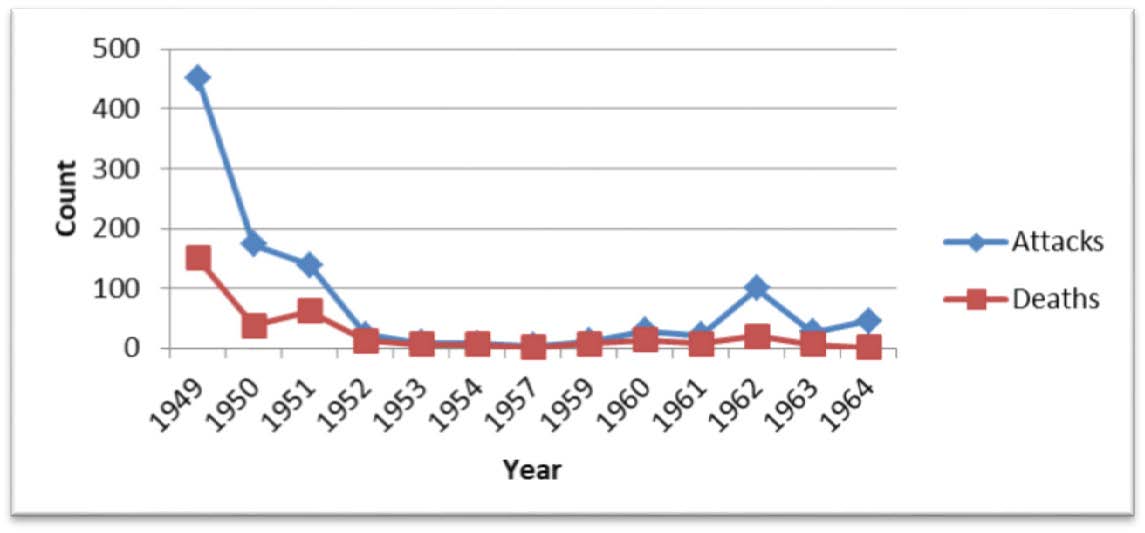
Figure 1. Number of Attacks and Deaths (1949-1964)
Conclusion
The successful eradication of the plague in Madras state by 1965 stands as a testament to the efficacy of comprehensive public health strategies and coordinated governmental action. The outbreak, driven by a combination of environmental and social factors, posed significant challenges to the region’s health infrastructure. However, through persistent efforts in surveillance, vaccination, vector control, and public education, the authorities managed to bring the epidemic under control. The lessons learned from this period have had a lasting impact on public health polices in India, particularly in the areas of disease prevention and outbreak management. This historical case study serves as a reminder of the critical importance of preparedness, timely intervention, and community engagement in the fight against infectious diseases. The success in Madras state offers valuable insights that continue to inform modern public health practices and highlight the enduring relevance of these strategies in combating emerging infectious diseases.
Authors’ Contribution
Durairasu Sharmila came up with the idea for the study, designed it, did archival research on the Plague epidemic, looked at historical public data, and write and edit the manuscript. Thangarasu Asokan, assisted with gathering and analysing data, reading and interpreting it, and writing, editing, and approving the final version of the manuscript. All authors read and approved the final version of the work.
Funding
None.
Conflict of Interest
None.
References
- Bhalwar, R., (ed.), 2009. Textbook of Public Health and Community Medicine. Department of Community Medicine. Pune: Armed Force Medical College..
- Madras Information, 1974. [Manuscript] No. 1-14. Held at: Madras: Fort. St. George, Director of Information and Publicity.
- Madras State Administration Report, 1951-52. [Manuscript] Part II. Held at: Chennai: Tamil Nadu Archives Library..
- Madras State Administration Report, 1952-53. [Manuscript] Part I & II. Held at: Chennai: Tamil Nadu Archives Library..
- Madras State Administration Report, 1953-54. [Manuscript] Part I. Held at: Chennai: Tamil Nadu Archives Library..
- Madras State Administration Report, 1955-56. [Manuscript] Part I. Held at: Chennai: Tamil Nadu Archives Library..
- Madras State Administration Report, 1957-58. [Manuscript] Part I & II. Held at: Chennai: Tamil Nadu Archives Library..
- Madras State Administration Report, 1961. [Manuscript] Held at: Chennai: Tamil Nadu Archives Library..
- Madras State Administration Report, 1963. [Manuscript] Held at: Chennai: Tamil Nadu Archives Library..
- Madras State Administration Report, 1964-65. [Manuscript] Held at: Chennai: Tamil Nadu Archives Library..
- Magammadh, V.R., 2020. Vempalli Raj Magammadh, Plague Mortality and Control Policies in Colonial South India, 1900-47. South Asia Research, 40(3), p. 338.
- Report on the Health Conditions in Madras State, 1951. [Manuscript] Held at: Chennai: Tamil Nadu Archives Library.
- Report on the Health Conditions in Madras State, 1952. [Manuscript] Held at: Chennai: Tamil Nadu Archives Library.
- Report on the Health Conditions in Madras State, 1954. [Manuscript] Held at: Chennai: Tamil Nadu Archives Library.
- Report on the Health Conditions in Madras State, 1959. [Manuscript] Held at: Chennai: Tamil Nadu Archives Library.
- Report on the Health Conditions in Madras State, 1960. [Manuscript] Held at: Chennai: Tamil Nadu Archives Library.
- Report on the Health Conditions in Madras State, 1962. [Manuscript] Held at: Chennai: Tamil Nadu Archives Library.
- Report on the Health Conditions in Madras State, 1965. [Manuscript] Held at: Chennai: Tamil Nadu Archives Library.

